


A motorists’ lobby group has raised alarm over what they term a hidden clause in the Rironi–Nakuru–Mau Summit Expressway project that could force Kenyans to pay toll charges without the option of using alternative routes, despite government assurance that an alternative way will be provided.
According to the Motorists Association of Kenya, provisions in the reviewed tolling policy by the Kenya National Highways Authority (KeNHA) and the Public Private Partnerships (PPP) Directorate grant the concessionaire the right to operate without any competing or alternative routes.
“We have reviewed the tolling policy issued by KeNHA and the PPP Authority, domiciled at the National Treasury, and can now confirm that one of the conditions granted to the concessionaire is the deliberate prohibition of any alternative route, which is intended to guarantee the project’s financial viability,” the association stated.
Adding that: “The devil, indeed, is in the details. This is the small print that KeNHA and the PPP Engineer, Seda, are concealing from the public.”
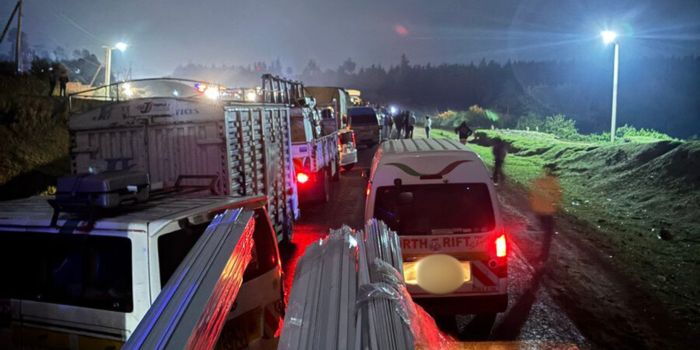
Motorists stranded in traffic on the Nairobi-Nakuru Highway on Wednesday, September 3, 2025.
Photo | Soko Analyst
Meanwhile, Kenyanewsmedia.co.ke took a review to establish whether the claims are indeed true. We established that the concern stems from a clause in the Draft Road Tolling Policy 2025 under Section 6(d) titled Toll-Free Alternative.
The section explicitly reads: “Where there are existing alternative routes of acceptable standards for road users to commute to their destinations, it will not be mandatory to provide a dedicated toll-free alternative, especially where it will be deemed to impact on the commercial viability of the Toll Road.”
Accordingly, as things stand, the clause effectively gives room for concessionaires to operate toll roads without maintaining a parallel free route.
However, the tolling policy remains a draft and has yet to be formally gazetted or adopted by the government. The Ministry of Roads and Transport and the PPP Directorate are still subjecting it to stakeholder review, meaning it does not yet carry the force of law.
Currently, toll operations in Kenya are guided by the Public Finance Management (National Roads Toll Fund) Regulations, 2021, which outline how toll revenues are collected, managed, and disbursed through the National Toll Fund.
These regulations do not contain any clause barring the creation of alternative roads or guaranteeing financial viability to private investors, and they primarily focus on revenue management and compliance.
Meanwhile, the motorists have accused KeNHA of using the draft policy to justify tolling the existing Nairobi–Nakuru highway instead of developing an entirely new parallel expressway.
They further challenged the rationale behind the public-private partnership, insisting that local motorists would be capable of funding the road through a transparent arrangement with KeNHA.
“They want to expand the Rironi section on the existing highway and then charge motorists a toll for using the very road they have used freely for years. A true BOT model builds its own independent road and leaves the existing one free, so that paying becomes a matter of choice, not coercion,” the association added.
“A fraction of 600 billion wastage public money will upgrade the highways with ease. We demand a section-by-section review of the expansion. We are not in a hurry to enter into latter-day control of our most valued asset, the Northern Corridor. We, as motorists, would easily fund the road through a special fundraising agreement with KeNHA since they have failed in their mandate.”
Motorists now want the government to halt plans that could lead to monopoly control of the Northern Corridor and instead pursue a model that guarantees transparency and affordability for Kenyan road users.

A massive traffic jam between Kinungi and Flyover caused by a road mishap involving multiple vehicles on July 13, 2025.
Photo | LoDCA